Frontier AI models are becoming increasingly capable and widely accessible. They can reason, summarize, generate content, write code, and interact with enterprise systems through tools and agents.
Yet access to powerful models does not automatically create enterprise intelligence.
Models do not inherently understand a company’s proprietary data, business definitions, operating model, policies, relationships, institutional knowledge, or strategic priorities. They may know how to reason, but they do not know enough about a specific enterprise to reason reliably on its behalf.
Organizations therefore need the ability to connect increasingly powerful AI models to the information and context that make their businesses unique.
That capability is the System of Intelligence.
In my view, a System of Intelligence is an enterprise-owned capability that connects governed data, shared business meaning, operational context, policies, and institutional knowledge so AI can support decisions and enable controlled action.
It is not a replacement for existing enterprise architecture. It is the next progression.
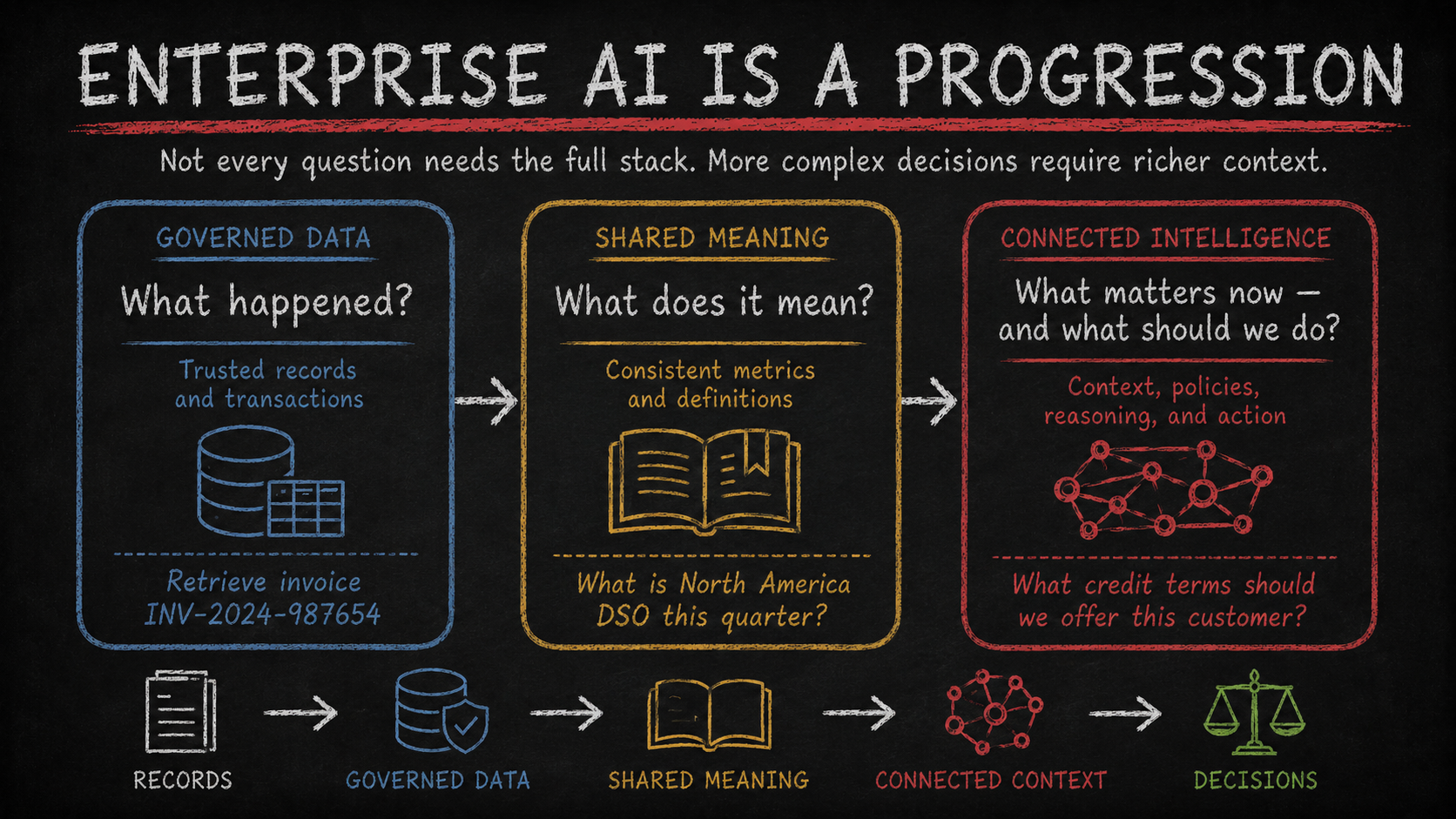
Enterprise AI is a progression
Organizations already operate several mature categories of enterprise systems.
Systems of Record execute business processes and capture transactions. ERP, CRM, asset-management, financial, and operational applications record what happened.
Governed data platforms and data products integrate that information and make it secure, reliable, reusable, and accessible.
Systems of Reference provide consistent business meaning through semantic models, KPI definitions, hierarchies, reference data, and business terminology.
Systems of Engagement bring information into the applications and channels where employees work, collaborate, make decisions, and take action.
Each capability plays an important role. But complex enterprise AI requires an additional layer that connects them.
The progression can be understood through three increasingly sophisticated types of questions.
Governed data: What happened?
A user may ask:
Retrieve invoice INV-2024-987654.
This requires secure access to a trusted transaction. It does not require an enterprise ontology or Context Graph.
Shared meaning: What does it mean?
A user may ask:
What is North America’s days sales outstanding this quarter compared with last quarter?
The question requires more than access to invoice data. It requires governed definitions, consistent calculations, business dimensions, and an understanding of which customers and transactions belong to the analysis.
Connected intelligence: What matters now, and what should we do?
A user may ask:
What credit terms should we offer this customer based on its payment behavior, current exposure, contractual position, industry conditions, and our risk policies?
This question requires context that spans multiple systems and domains. It may require relationships, current state, policies, external signals, historical decisions, risk tolerance, and available actions.
This is where the System of Intelligence becomes essential.
Enterprise AI progresses from accessing records, to understanding meaning, to reasoning over connected business context.
Not every use case needs the full progression. A transaction lookup should remain simple. Standard reporting may be served effectively through governed data and semantic models.
The objective is not to apply every architectural component to every question.
The objective is to build the enterprise capability required when the complexity and value of a decision demand it.
What belongs in a System of Intelligence?
A System of Intelligence is not one database, graph, model, or application. It is a logical enterprise capability that may include:
- Enterprise and domain ontologies
- Knowledge and Context Graphs
- Semantic models and governed definitions
- Current operational state
- Policies, rules, and constraints
- Organizational relationships
- Decision history and institutional memory
- Context assembly for users and agents
- Reasoning and inference
- Recommendations and permitted actions
- Feedback from decisions and outcomes
The ontology provides the shared language through which enterprise concepts and relationships can be understood.
Knowledge and Context Graphs connect those concepts to actual business entities, events, policies, decisions, and outcomes.
Reasoning capabilities use that context to identify what matters within a particular situation.
Systems of Engagement then bring the resulting intelligence into tools such as Copilots, Teams, business applications, decision workbenches, and agent workflows.
A useful distinction is:
Systems of Record capture what happened. Systems of Reference establish what it means. Systems of Intelligence determine what matters in context and what should happen next. Systems of Engagement bring that intelligence into the flow of work.
Why powerful models are not enough
Frontier models provide increasingly sophisticated generalized intelligence. They can recognize patterns, interpret language, analyze alternatives, and construct plans.
But they do not inherently possess:
- A company’s proprietary operational data
- Its authoritative business definitions
- Its current organizational relationships
- Its policies and decision rights
- Its historical exceptions and precedents
- Its strategic objectives
- Its risk appetite
- Its institutional experience
- The actions a particular user or agent is authorized to take
Giving a model access to documents, databases, or APIs helps, but access alone is not the same as understanding.
The more important question is whether the model can identify the right information, interpret it consistently, connect it across domains, apply the appropriate policies, and explain the basis of its recommendation.
Frontier models provide generalized intelligence. The System of Intelligence provides company-specific understanding.
This connection between powerful models and proprietary enterprise context is where much of the differentiated value of AI will be created.
Enterprise-owned, vendor-enabled
Technology providers will play an important role in building Systems of Intelligence.
They can provide:
- Foundation models
- Data and AI platforms
- Semantic modeling tools
- Graph technologies
- Agent frameworks
- Retrieval and orchestration
- Security and governance capabilities
- Industry accelerators
- Managed services
A strategic platform may implement several components of the architecture.
But no software vendor can independently define what a company’s business means, which relationships matter, how trade-offs should be evaluated, which exceptions are valid, or what risks the organization is prepared to accept.
Those decisions belong to the enterprise.
A System of Intelligence can be platform-enabled, vendor-supported, and externally operated. But it cannot be externally owned.
The enterprise must retain ownership of:
- Strategic intent
- Business meaning
- Authoritative definitions
- Policies and controls
- Decision rights
- Institutional memory
- Outcome accountability
The platform can be outsourced. The intelligence cannot.
Enterprise ownership requires federation
Enterprise ownership does not mean that one central team should attempt to model the entire organization.
Large enterprises contain many domains with specialized knowledge, processes, definitions, and decisions. A central team cannot possess or maintain all of that detailed intelligence.
The scalable operating model is federated.
A centrally governed foundation should establish the minimum context required for the organization to operate as a connected enterprise. This may include shared identities, foundational concepts, interoperability standards, security, provenance, enterprise policies, and decision structures.
Business domains should own the detailed intelligence closest to their operations, including domain concepts, relationships, rules, data mappings, decisions, and context quality.
The result is a simple principle:
Centralize governance of the foundation. Federate ownership of the intelligence.
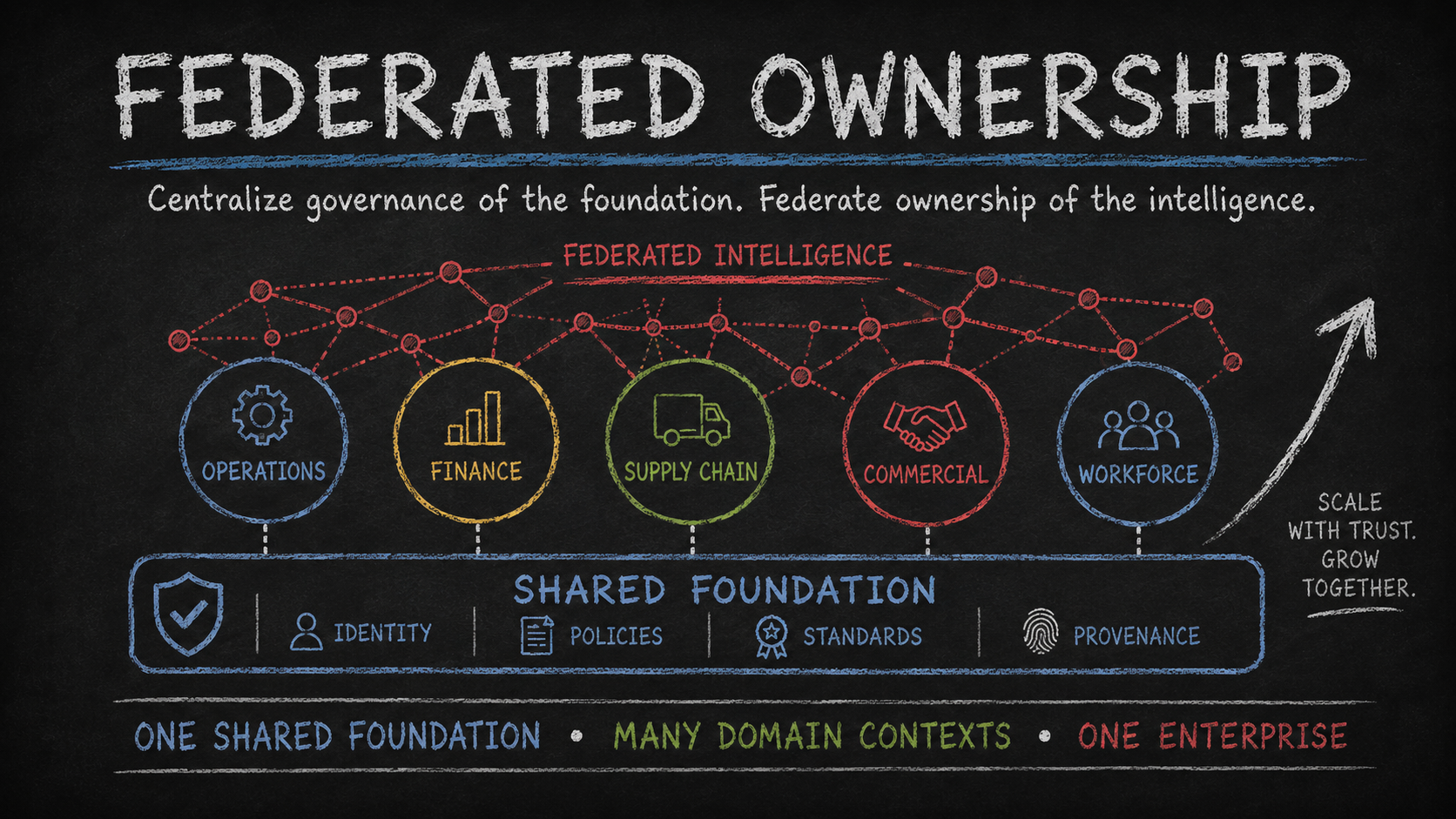
Without central governance, federation becomes fragmentation. Without domain ownership, central governance becomes a bottleneck.
A capability that must be funded and staffed
A System of Intelligence will not emerge organically from a collection of AI projects.
Without deliberate investment, each project will independently recreate business definitions, data mappings, retrieval logic, policies, prompts, and decision rules. The organization will produce another generation of silos, this time embedded inside AI solutions.
Building the capability requires sustained enterprise focus.
The reusable foundation should be funded as an enterprise capability. Business domains and use cases should fund the detailed intelligence that produces measurable value.
The operating model may require:
- Executive sponsorship
- Product leadership
- Semantic and knowledge architecture
- Data and graph engineering
- Governance and risk expertise
- Domain business ownership
- AI evaluation and observability
- Change management
- A federated community of domain stewards
Meaning does not govern itself. Context does not remain current by itself. Institutional intelligence does not appear because a graph platform was installed.
It must be built, governed, and continuously cultivated.
From governed data to governed intelligence
Enterprise AI is not a direct jump from data to autonomous agents.
It is a progression:
Records → Governed data → Shared meaning → Connected context → Reasoning → Decisions → Action
Organizations should not build the entire progression for every use case. They should establish it as a reusable capability and activate the appropriate components based on the complexity, risk, and value of the decision.
Systems of Record will continue to run the enterprise. Systems of Reference will continue to provide governed meaning. Systems of Engagement will continue to define where people and agents interact.
The System of Intelligence connects them.
It gives powerful AI models access not only to enterprise data, but also to the business meaning, relationships, policies, and institutional knowledge required to use that data responsibly.
AI models can be acquired. Enterprise intelligence must be built.
That is why Systems of Intelligence are becoming an essential progression for enterprise AI.